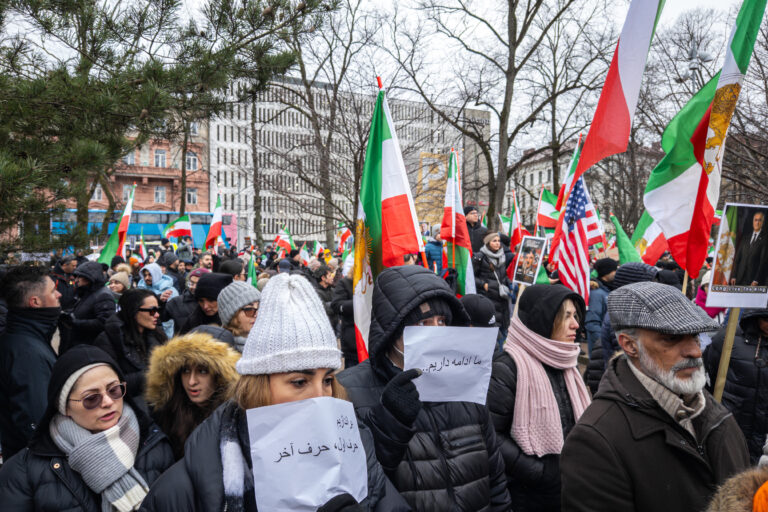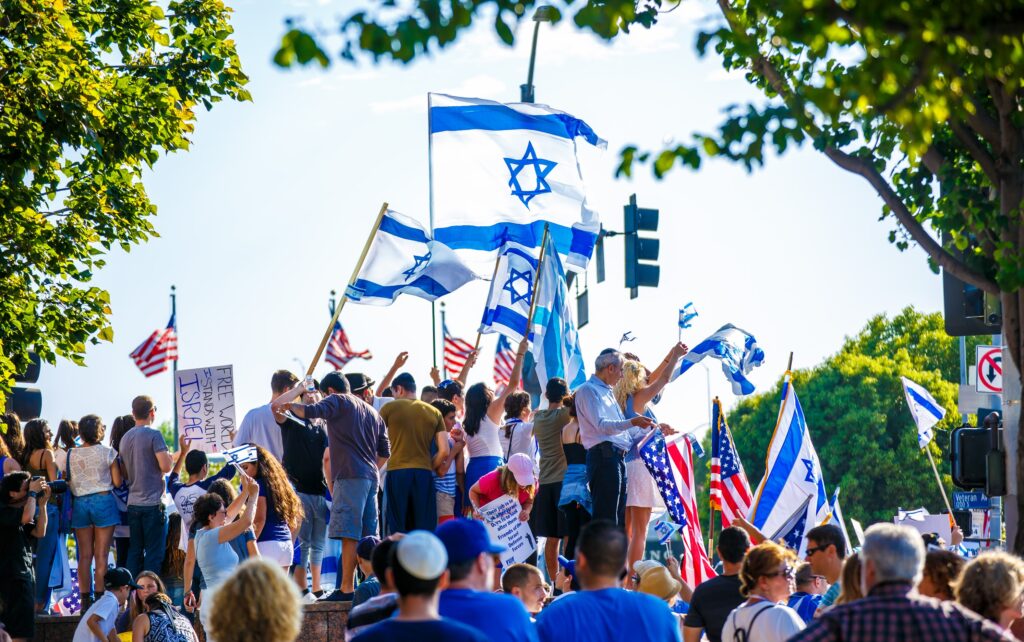
Pro Israel Rally / Los Angeles CA
The rationale for U.S. support was—and remains—multifaceted, with significant reciprocity that critics strategically ignore.
By Susan D. Harris
The nation’s news consumption has shifted to a fragmented array of emotion-driven podcasters, commentators, and sensationalized social media feeds. History is no longer a fixed record of what happened; it has become Play-Doh for digital provocateurs—who mold it and shape it to suit whatever narrative they’re selling.
As a result, many know nothing of Israel’s history or her oppressors. They can’t differentiate between Hamas and Hezbollah, nor find Lebanon, Yemen, or Iran on a map. Led by political firebrands looking for clicks, they don keffiyehs, chant “from the river to the sea,” and sit at their keyboards posting #GazaGenocide memes.
So let’s take some time to discuss why the United States gives military aid to Israel: how it started, how it has changed over the years, and why we need an honest, fact-based discussion about what comes next—without the divisive rhetoric.
Not a Burden: Israel as America’s Front-Line Deterrent
In response to Tucker Carlson’s criticisms labeling Israel an “insignificant” burden, historian Victor Davis Hanson defended the alliance. He emphasized its tangible benefits to the United States, including intelligence sharing, cutting-edge technologies, and deterrence against shared threats such as Iran and its proxies.
“Does Tucker really believe that Hezbollah, Hamas, and the Houthis are not enemies of the United States?” Hanson asked. “We don’t have any soldiers fighting Hezbollah. They blew up our marines. They blew up our embassy. The Houthis attacked our ships. Hamas people have committed terrorist [acts]. Who has deterred them? The Israelis have.”The Many Reasons for America’s Widespread Support
In my article—“America’s Role in Israel’s Creation and Survival, and Why We Care”—I outlined the enthusiastic ideological U.S. support for establishing the state of Israel. I proved that as early as 1927, money was flowing in from around the world to purchase land for a Jewish homeland. For decades, American Jews and non-Jews alike contributed large sums of money to this end. The reasons for this support were many and varied.
Some non-Jewish Americans supported Israel’s creation as a rejection of British imperialism in Palestine—it was their misconceived “anti-colonial” backlash against the British Mandate (a view you would think many activists today would embrace).
Additionally, post World War II, guilt likely set in because of the United States’ restrictive immigration policies and lack of refugee status. The world had witnessed a real genocide: Jews dragged out of their houses in country after country—tortured and slaughtered simply for being born Jewish.
Amid the carnage, hundreds of thousands of Jews were denied immigration to the United States from 1933 to 1945. Since many of them remained trapped in Nazi-occupied Europe, it’s safe to assume that a great number were murdered despite their desperate attempts to flee. (Which is pretty horrific if you think about it: What if you spent months or years trying to save yourself or your family from being murdered, only to face the very death that had tormented your every thought?)
There were also many Christian Americans who viewed the Jews’ return to their homeland as a fulfillment of biblical prophecy.
In a public school in New York state in 1948—as my mother, who was 14 years old at the time, recalled—her teacher interrupted class to announce the establishment of the state of Israel. Israeli leader David Ben-Gurion had read the Israeli Declaration of Independence at 4 p.m. Israel time, with news bulletins reaching U.S. radio and wire services between 10 a.m. and 11 a.m. Eastern Time that morning—easily monitored by schools via office radios. The teacher explained that the Jewish people’s return to their ancestral homeland fulfilled biblical prophecy, then read a relevant Bible verse aloud. (Remarkably, in 1948, this did not trigger a community uproar or the teacher’s resignation.)So while some saw the Jewish state through the lens of eschatological prophecy, others supported it (or accepted it) as a practical alternative to bringing Jewish refugees to U.S. shores. They feared that admitting more European Jews would import more of Europe’s political and social problems. We had, after all, just sacrificed two generations of young men to clean up foreign messes “over there.”
No Help From the US: Israel Fought and Won Alone in 1948
It’s undeniable that, as Israel declared statehood, it clearly had the moral, financial, diplomatic, and political backing of an enthusiastic American public. What it didn’t have was government financial or military support.
In fact, the United States—through a State Department embargo—banned arms shipments to all parties in the Middle East from December 1947 through much of 1949.
While the United States strictly withheld weapons from everyone, the UK continued to arm several Arab states, leading up to and during the early phases of the 1948 Arab–Israeli War, although it imposed restrictions later on.
As a result, Israel’s survival in the 1948 War of Independence relied on makeshift solutions: smuggling leftover Nazi-era arms from Czechoslovakia (with Soviet approval via Operation Balak), establishing underground factories for rudimentary munitions, and operating a secret bullet factory beneath a kibbutz laundry and bakery—all necessarily hidden from the British, who were still there administering the League of Nations Mandate (1920–1948).
So far, we have seen that the Yishuv—the pre-state Jewish community in Palestine—along with Holocaust survivors and other post-World War II immigrants, fought tenaciously with their own blood, sweat, and tears to establish the state of Israel. It’s an amazing story; there’s nothing like it in the annals of history. Significant U.S. government assistance in the form of grants, loans, and advanced weaponry would only emerge later, driven primarily by strategic interests and historical ties.
The Evolving Nature of US Aid
Generally speaking, U.S. military support for Israel crystallized during the Cold War. After World War II, the Soviet Union actively aligned itself with Egypt and Syria as part of a broader strategy to counter Western (U.S., British, and French) influence in the Middle East. Conversely, the United States came to see Israel as an ally in the quest to contain Soviet expansion.
At first, aid was modest: U.S. President John F. Kennedy’s sale of Hawk missiles in the 1960s broke the longstanding U.S. arms embargo on major weapons to Israel.
Yet by 1967, Israel faced an imminent existential threat from hostile Arab nations, which included a massive military buildup on their borders, as well as the closure of the Straits of Tiran to Israeli shipping (a casus belli). Israel launched airstrikes against Egypt, as well as ground offensives against Egypt (Sinai), Jordan (West Bank and East Jerusalem), and Syria (Golan Heights). They achieved a stunning victory in only six days. While the United States offered political backing, it remained neutral, offering no active combat or arms aid during the conflict.
When Egypt and Syria launched a coordinated, simultaneous surprise assault across the Suez Canal in 1973 (the Yom Kippur War), Israel began to run low on ammunition. U.S. President Richard Nixon then authorized Operation Nickel Grass—a 32-day airlift delivering tanks, jets, and supplies to save the struggling country. This Herculean effort was a turning point, but it came with strings attached.
The United States leveraged its support to enforce a cease-fire, preventing Israel from fully capitalizing on battlefield gains to facilitate future peace negotiations (invoking the “Land for Peace” idea that originated at the United Nations in 1967).
Aid evolved from loans to grants in 1974, formalized as Foreign Military Financing (FMF). These were basically “coupons” that allowed Israel to buy from U.S. manufacturers such as Boeing and Lockheed Corp., tying aid to U.S. economic interests.
U.S. President Jimmy Carter’s 1979 Camp David Accords—ceding Sinai to Egypt—prompted quadrupled aid to offset Israel’s security losses (but included similar packages for Egypt). Egyptian President Anwar Sadat paid with his life, assassinated by Islamic Jihad less than three years later.
Similar aid patterns followed the Oslo Accords of 1993 under U.S. President Bill Clinton. Israeli Prime Minister Yitzhak Rabin paid with his life roughly two years later, killed by a Jewish extremist.
Aid increases were thus consistently tied to Israel relinquishing strategic territory to offset security losses. Formalized through memorandums of understanding, aid escalated from $1.7 billion in the 1970s to $3 billion by 2007 (under the George W. Bush administration) and $3.8 billion annually from 2016 (under the Obama administration). But these 10-year agreements only deepened Israel’s dependency.
Initially, roughly 25 percent of FMF could go back into Israeli industries, but U.S. President Barack Obama’s 2016 MOU phased this out, requiring full spending in the United States—a boon for U.S. companies but one that drastically harmed Israel’s domestic defense production.
Israeli munitions lines closed in the 2000s, as “free” vouchers made off-the-shelf U.S. purchases cheaper. The post-Oct. 7, 2023, war exposed vulnerabilities. Israel excelled in high-tech defense (precision weapons, drones, and missile systems), yet shortages hit because of reduced or scaled-back domestic production for conventional munitions, combined with global supply constraints—including “silent boycotts.”
Additionally, U.S. President Joe Biden temporarily withheld high-payload bombs from Israel amid political pressures, maintaining a partial arms embargo throughout the remainder of his term. Memorandums of understanding themselves are not legally binding, and such actions fall within the purview of whoever occupies the White House.
Yes, the Numbers Are Staggering
Since 1948, the United States has given Israel more than $174 billion in total aid (not adjusted for inflation), or roughly $300 billion after adjustment, making Israel the largest recipient of U.S. foreign aid in history.
Pundits today often portray Israel as happy to stay dependent on U.S. aid, yet Israeli’s have expressed concerns about reducing that dependence long before the Oct. 7, 2023, Hamas attacks.
Raphael BenLevi, director of the Churchill Program at the Argaman Institute, has been leading the charge for reducing and eventually eliminating Israel’s reliance on U.S. military aid.
Renowned journalist Caroline Glick, now international affairs adviser to Israeli Prime Minister Benjamin Netanyahu, interviewed BenLevi last year. They argued that FMF grants distort priorities: Budgets favor U.S. “coupons” over domestic capabilities. They also tie Israel to potential hostile administrations—a situation BenLevi called “acute and extreme in the past year.”
Furthermore, dependency undermines moral equality—U.S. critics demand obedience for “handouts” that Israelis see as bribes.
“We’ve dug ourselves into this dependency. It’s like welfare. People on welfare get used to having a certain amount of external aid,” BenLevi wrote in December 2024. “A day comes when they have to rearrange their affairs in order to manage without it.”
Apparently, Netanyahu agreed. According to the Jerusalem Post, Netanyahu just “publicly pitched one of the most radical transformations in US relations in decades, announcing he planned to zero out US military aid by 2038.”
This should have come as no surprise, as he had previously announced a “10-Year, $110 billion plan to cut reliance on foreign weapons,” according to The Media Line.
But the Return Has Been Incalculable
The rationale for U.S. support was—and remains—multifaceted, with significant reciprocity that critics strategically ignore:
- Strategic Alignment: Originally, Israel countered Soviet influence and, later, radical Islamist threats such as Hezbollah, Hamas, and the Houthis. A common analogy describes Israel as the United States’ “unsinkable aircraft carrier” in the Middle East—providing forward positioning, deterrence, and a reliable partner without requiring U.S. boots on the ground.
- Economic and Technological Benefits: Aid recirculates into the U.S. economy, funding jobs and industries. Most importantly, Israel shares battle-tested innovations and research and development worth billions of dollars. These include adaptations to F-35 jets, cybersecurity tools, drones, artificial intelligence-powered warfare solutions, and joint developments such as the Iron Dome—notably through the Marine Corps’ MRIC program, which uses Tamir interceptors. In short, Israel’s technology may one day save the United States the same way we saved Israel.
- Israel leads in per-capita Nobel Prizes and inventions, with its military-tech sector producing advancements that directly enhance U.S. capabilities.
- Intelligence and Military Cooperation: Israel provides critical, real-time intelligence on Iranian nuclear sites, as well as terrorist and regional threats, enabling U.S. operations. As the region’s only true democracy—with full rights for Arab citizens—Israel contrasts sharply with the autocratic Gulf states.
In an era of distorted internet narratives, cherry-picked memes, and uninformed outrage, we owe this generation the truth: the story of how Israel stands as a solitary beacon of democracy amid storms of tyranny—a nation reborn from ashes, forged in courage, and sustained by an unbreakable will to survive. To forsake her would be to extinguish the light of shared values that we claim to cherish: liberty, resilience, and the right of a people to defend their ancient homeland against those who want to annihilate it.
Originally published in The Epoch Times https://www.theepochtimes.com/opinion/how-america-went-from-arms-embargo-to-israels-biggest-backer-5968649