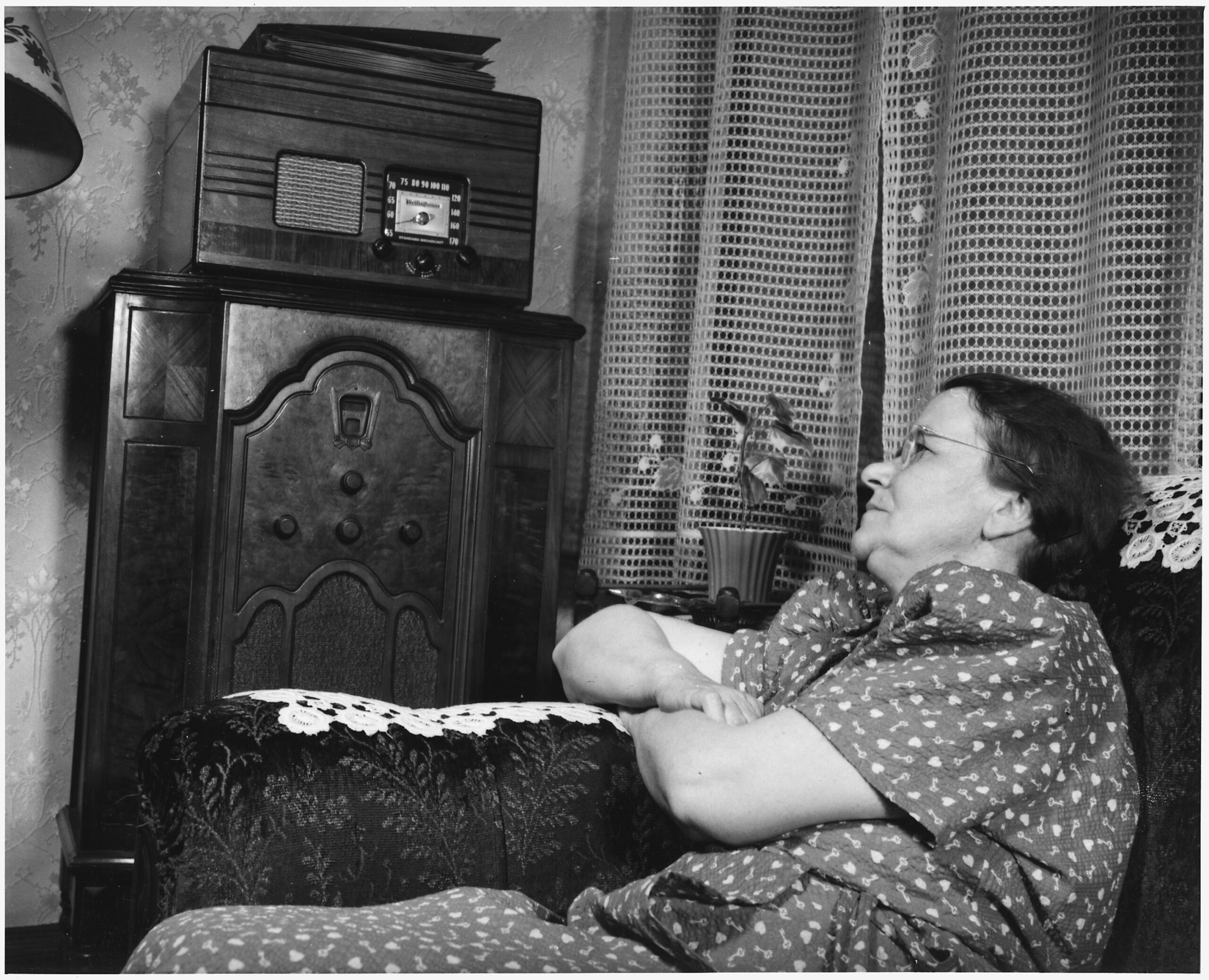
Radio allowed Christmas traditions to travel farther than ever before, uniting families, soldiers, and strangers in shared celebrations.
Christmas on the Air: Heartwarming Highlights from the Golden Age of Radio
By Susan D. Harris
The Golden Age of Radio—the 1920s through the 1950s—is often called the “theater of the mind.” Before that, entertainment meant going to a theater: from the ancient stone rows of Athens’ Theater of Dionysus to the velvet seats of Ford’s Theatre in Washington, D.C., people left their homes to become part of a communal audience. The introduction of radio would change all that. From breaking news to weather forecasts, from aviation safety to shipping navigation, it reshaped everyday life—and, most magically of all, it revolutionized how we were entertained. For the first time in history, plays, concerts, comedies, and ghost stories could wander into any home via the airwaves. Even Christmas itself could waft in and brighten a dark December night.
Do You Hear What I Hear?
Fittingly, the first faint notes of that miracle sounded at Christmastime—on a quiet December night in 1906.
Reginald Fessenden was a Canadian scientist who came to America to work with the best of the best. After stints at Edison and Westinghouse, Fessenden co-founded the National Electric Signaling Company and built a towering station at Brant Rock, Massachusetts—determined to send the human voice across the Atlantic.
It seems providential—or at least serendipitous—that the first radio broadcast of sound and voice came from Brant Rock—just a stone’s throw from Plymouth Rock. Fessenden’s landmark radio station made history on December 21, 1906: for the first time, radio waves carried the human voice and music instead of the dots and dashes of Morse code.
After Fessenden’s pioneering work in the introduction of AM radio, the technology evolved rapidly. By 1920, KDKA in Pittsburgh had launched the world’s first licensed, commercial radio station, and broadcast the Harding–Cox election returns on November 2. It’s estimated that around 1,000 people, likely listening on homemade radios, learned that William Harding was president before the rest of the country. The Golden Age of Radio had begun, and everyone wanted in on it.
Have a Holly Jolly Christmas
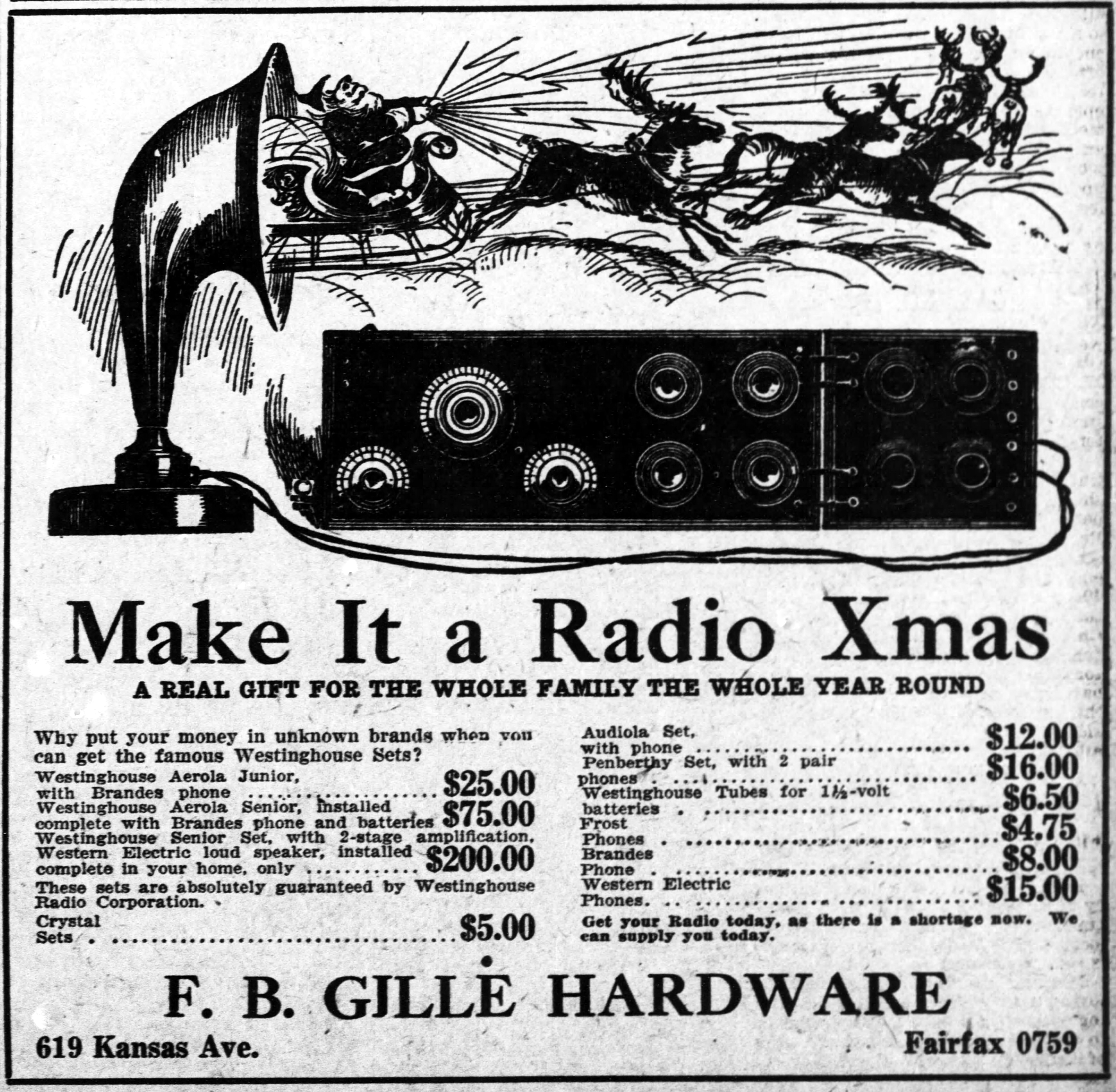
By 1922, radio had become the world’s first true consumer electronic. It was the height of the radio craze and the advent of the “radio Christmas.”
The Niagara Falls Gazette told its readers to “prepare for a radio Christmas. This is the word given out by several manufacturers who are planning to flood the market with all kinds of radio gifts.” The NEA News Service declared, “Unknown less than two years ago, [radio] has grown to rival baseball, automobiling and the movies in national popularity.”
Radio Digest wrote: “The special Christmas programs given at the different stations have been such that each has tried to outdo the other in quality and in distance work.”
By the late the 1920’s, nearly 40% of households had a radio, and Christmas on the airwaves had become a national event.
On December 22, 1922, New York’s WEAF broadcast the first radio reading of Charles Dickens’s “A Christmas Carol.” Other stations followed suit, and by 1928 the Columbia Broadcasting System (CBS) was performing the story on the air with a full cast.
King George V, of the United Kingdom, delivered that country’s inaugural “Christmas Broadcast” on December 25, 1932, from Sandringham House. U.S. President Franklin D. Roosevelt gave the first White House Christmas address over the air on December 24, 1933, right after lighting the national Christmas tree.
On December 24, 1934, CBS aired the first ever production of “A Christmas Carol” with Lionel Barrymore as Scrooge. Barrymore reprised the role 17 more times, making it one of his signature performances. In a 1947 interview, Barrymore said, “I seem to shrink and an unnatural meanness of disposition comes over me. I seem to be Scrooge in body and mind.” He added, “Of all the roles I’ve done, the one I’d like best to be remembered for is Scrooge. It is unquestionably one of my favorites.”
Oh Holy Night
Amidst the pain and darkness of WWII, radio emerged as a vital beacon of hope. The Armed Forces Radio Services was formally established in 1942 to broadcast to American Servicemen.
On the homefront, radio could reach out to loved ones in harm’s way halfway around the world and bring them to the safety of our living rooms. The groundbreaking “Christmas Eve at the Front,” broadcast on December 24, 1943, will still send a shiver down the spine. In a pre-satellite world, the program was a technological milestone. Incorporating shortwave technology, it wove live, real-time feeds from war zones around the world into a single, cohesive broadcast that was simulcast on CBS, NBC, and Mutual.
The beloved voice of Christmas Eve introduced the show: “This is Lionel Barrymore in Hollywood and here it’s Christmas Eve—the third our country’s experienced in the war. But tonight, I’m not going to play the part of Scrooge. Let me rather take you people of America by the hand to the side of your loved ones fighting in every quarter of the globe … we’re going to Italy, North Africa, to New Guinea, Guadalcanal, New Caledonia, and for the first time on the radio we’ll take you to Munda [Soloman Islands]. We’ll visit China, where it already is Christmas; we’ll go to India, Panama, and Alaska, Pearl Harbor, and some of our ships of the Navy…”
The show was hosted by comedian Bob Hope, who had begun his long tradition of entertaining the troops just two years prior. Bing Crosby was there too—singing his much-loved Christmas carols and improvising with Bob as they waited for Alaska to dial in.
O Little Town of Bethlehem
Perhaps the most awe-inspiring moment came when the broadcast took listeners to Bethlehem in the Holy Land, where it was 4:00 a.m. A chaplain and two American soldiers—one from Detroit, one from Brooklyn—addressed the audience as “representatives of the American army in the Middle East.” One of the sergeant’s describes how he “knelt with 60 other American boys on the side of the stable where Christ was born. An American chaplain officiated at a mass service … it was the first participation of the American Army in the Bethlehem family.” The other sergeant told how the Church of the Nativity was “filled with uniformed men—American, British, and Polish—so I knew there was still a war on, but somehow or other I felt there would soon be peace on Earth.” You can listen to this timeless classic in its entirety here on YouTube.
I’ll Be Home for Christmas
Another exceptional example of Christmas on the radio came a few years later on December 20, 1947.
H.C. Smith was a 19-year-old Shipbuilder 3rd Class in the U.S. Navy. He’d already laid in the Long Beach Naval hospital for 8 months after an accident in the shipbuilding yard. He was paralyzed from the neck down.
“Truth or Consequences” was one of radio’s first game shows. With host Ralph Edwards at the helm, he and his producers had arranged for H.C. to join the program by telephone.
What happened next was one of the most moving half-hours in radio history.
The episode was a technical triumph: a live, multi-location broadcast seamlessly linking the radio studio and its audience with the Naval Hospital—where H.C. was recovering—and dozens of friends and family back home in Greeneville, Tennessee.
While H.C. was happy just to hear the voices of his parents and his girlfriend Lila— everyone was surprised when they actually walked into his hospital room and spoke to him live on the broadcast. The emotion in H.C.’s voice was a moment of tender humanity that no one who heard the show would ever forget. As the show drew to a close, Ralph Edwards warmly thanked all the participants, and—most of all—the engineers and production crew whose painstaking work behind the scenes had made the amazing reunion possible.
Whatever happened to H.C. you ask? With the use of aids and prosthetics, he made a limited recovery, but remained a quadriplegic. Overcoming his limitations, he went back to Tennessee, finished college, bought a 225-acre farm, and married his girlfriend, Lila. They were together until her death in 1973.
In 2004, H.C. was 76-years-old and confined to a healthcare center in Greeneville. Residents, friends, and family hosted a “listening party” that Christmas, as the local radio station replayed the 1947 show in his honor. The Greenville Sun covered it here. Hubert C. Smith passed away two years later.
The Golden Age of Radio is long over, yet its voices never truly left; they are still racing through the cosmos, weaving among the stars, waiting for someone, somewhere, to tune them in—and let the past speak again.

Christmas on the Air: How Radio’s Golden Age Brought the Holidays Home | The Epoch Times