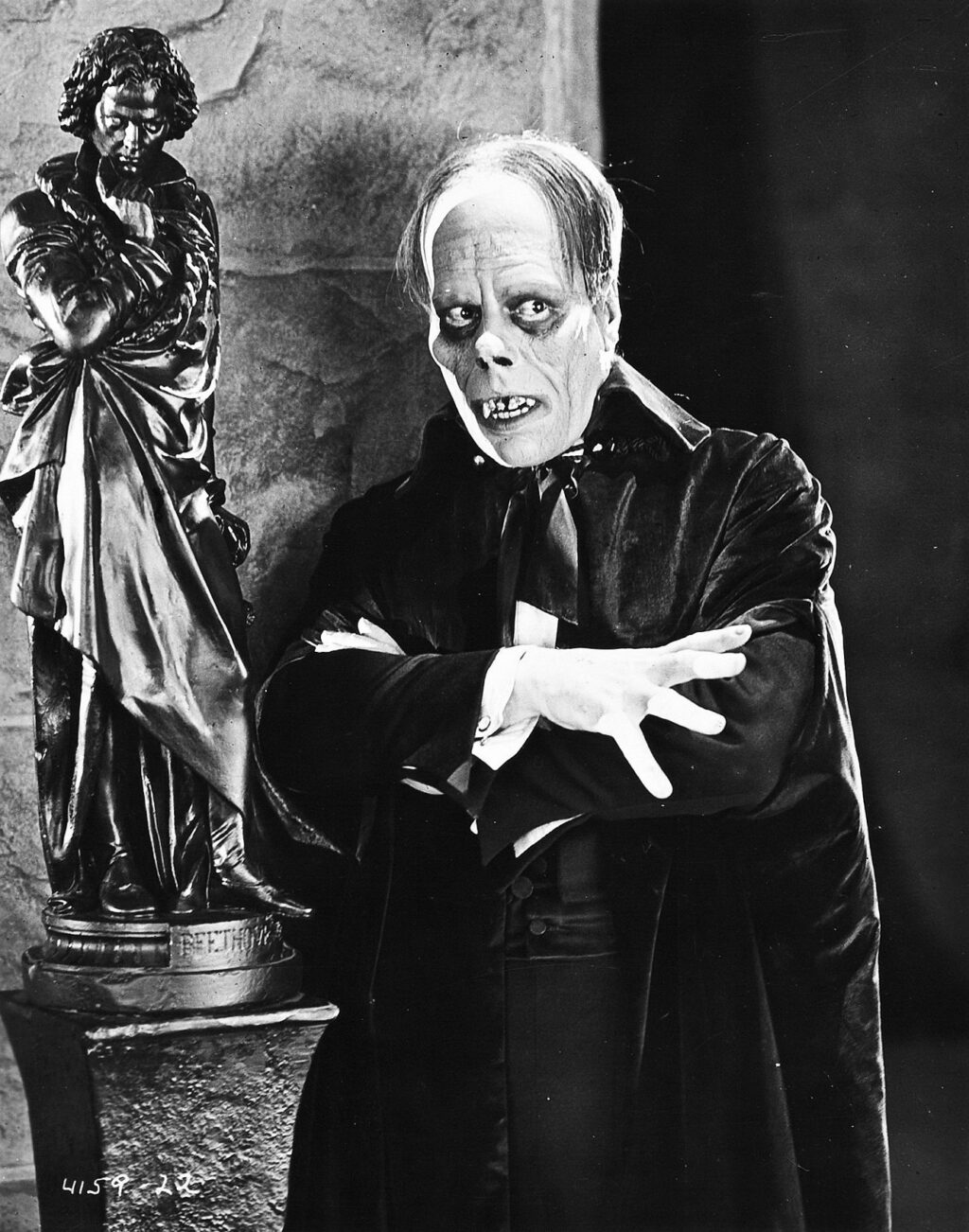
In the annals of cinema, few scenes have made such an impression as Lon Chaney’s unmasking in the 1925 silent masterpiece “The Phantom of the Opera.” Chaney’s Phantom—a disfigured genius haunting the catacombs beneath the Paris Opera House—originated in Gaston Leroux’s 1910 French novel Le Fantôme de l’Opéra, a tale now immortalized through countless retellings.
Held captive in the Phantom’s subterranean lair, the opera singer Christine suddenly tears away his mask. What stares back is pure nightmare: an elongated skull; eyes bulging from blackened sockets; a flattened, upturned nose; a gaping mouth of jagged teeth; and pallid, corpse-like skin.
According to Lea Stans, a columnist for Classic Movie Hub, when the movie originally came out, that scene caused some theater patrons to faint. Images of the phantoms face did not appear on promotional advertising for the film, purposely so the big reveal could produce a good jump scare.
Stans tells us that famed actor Gregory Peck, who would have been about nine years-old when “Phantom” was released, had the following recollection of the film’s climax:
“She snatched his mask off, and he turned his head to a close-up. He had no face, practically…my hair stood on end! I think my grandmother’s hair stood on end, too. I was positively stunned. After the picture we walked home and I held my grandmother’s hand all the way. It wasn’t until we got halfway home that I realized she was as frightened as I was. We were walking right down the middle of the street, terrified of the dark sidewalks.”
As we learned later, Chaney’s masterful transformation in “Phantom,” not unlike his other characters, often relied on the painful use of wires and other mechanical means to alter his appearance.
While Chaney portrayed hideous figures, he also wanted people to feel empathy for them. It was all part of the end game.
Though he rarely gave interviews, he revealed a huge part of his own character in 1925, when he told Movie Magazine:
“I wanted to remind people that the lowest types of humanity may have within them the capacity for supreme self-sacrifice. The dwarfed, misshapen beggar of the streets may have the noblest ideals. Most of my roles since ‘The Hunchback,’ such as ‘The Phantom of the Opera,’ ‘He Who Gets Slapped,’ ‘The Unholy Three,’ etc., have carried the theme of self-sacrifice or renunciation. These are the stories which I wish to do.”
It is believed that Chaney’s expressive genius was born out of a difficult childhood. In Colorado Springs, Colorado, where his mother is buried and where he spent his early childhood, they still pay homage to the Chaney family, but you might be surprised why.
In a recent post from Evergreen Cemetery in El Paso County, Colorado, they tell us:
“Both of [Lon Chaney’s] parents, Frank and Emma (Kennedy) Chaney, were deaf, and as Emma struggled with inflammatory rheumatism, her son spent hours at her bedside inventing wordless performances—pantomimes that mimicked neighbors, relayed the news of the day, and proved how a story could be told without sound.”
Chaney’s biographer, Michael F. Blake, concluded that “Chaney’s daily ritual honed the graceful movement and expressive hands that would later define one of the silent era’s greatest actors.”
Why does Colorado Springs still honor the family? Because Chaney’s maternal grandfather, Jonathan Ralston Kennedy, co-founded the Kansas School for the Deaf in 1861. Alongside deaf educator Philip A. Emery, he secured funding, rented the first building, and enrolled the initial students—including his own deaf children—making it the first school for the deaf west of the Mississippi.
Chaney’s struggles extended beyond his family’s deafness. He had to support his parents financially from a young age, working odd jobs like guiding tourists up Pike’s Peak. His natural talents led him to vaudeville in 1902. Eventually he married singer Cleva Creighton. That union ended tumultuously in 1913 when she attempted suicide onstage, leading to scandal and custody battles over their son, Creighton (later Lon Jr.).
Despite these hardships, Chaney starred in over 150 films, pioneering special effects makeup that changed the film industry. Tragically, he died of throat cancer in 1930 at age 47, just as talkies were emerging. His legacy of portraying the ostracized in a way that provoked empathy stemmed from his own life struggles, where he learned that true horror often lies in being pushed to the outskirts of society.
Many of Chaney’s movies were pure genius. Before there were special effects departments, before air brushing and CGI, Chaney created his own characters with nothing but ingenuity and a makeup case.
Chaney portrayed an amputee in at least four films, one of which was The Unknown (1927)—which also featured a breakthrough role for a young Joan Crawford. I love it because—not unlike Chaney’s other work—it’s so much more than a horror movie: it’s a morality play, a Greek tragedy, and a biblical tale of betrayal.
“The Unknown” features Chaney as an armless circus performer (Alonzo), who hides a dark secret—he actually has arms—to win the love of Nan (Joan Crawford), who fears men’s hands. Alonzo’s obsession with Nan leads to blackmail, betrayal, and a gruesome act of self-mutilation. It’s a complex look at self-sacrifice and the scars of physical and psychological trauma.
As a dedicated cinephile with a special love for early cinema, I’ve always been fascinated by Lon Chaney. He was the first Hollywood horror star and a self-made monster.
Taking up the family torch is Ron Chaney, Lon Chaney’s great grandson. His father, Lon Chaney Jr., best known as “The Wolfman,” also had a storied career in the horror genre.
I spoke with Ron a few years ago at a Comic-Con type event. Every year he travels the circuit, humanizing the family monsters and sharing endearing Chaney family stories. He and his daughters, Jennifer and Jaclynn, are keeping the family legacy alive via Chaney Entertainment Inc. Ron is currently working on “The Phantom of the Opera” graphic novel campaign. You can find more details on his Facebook page.