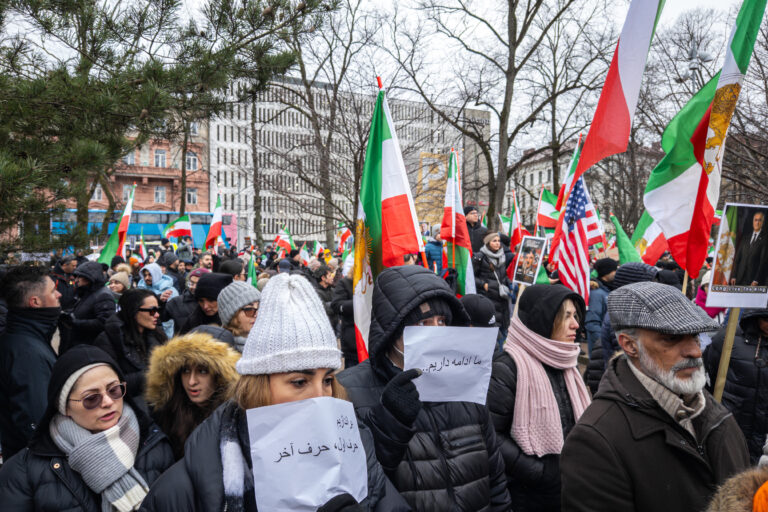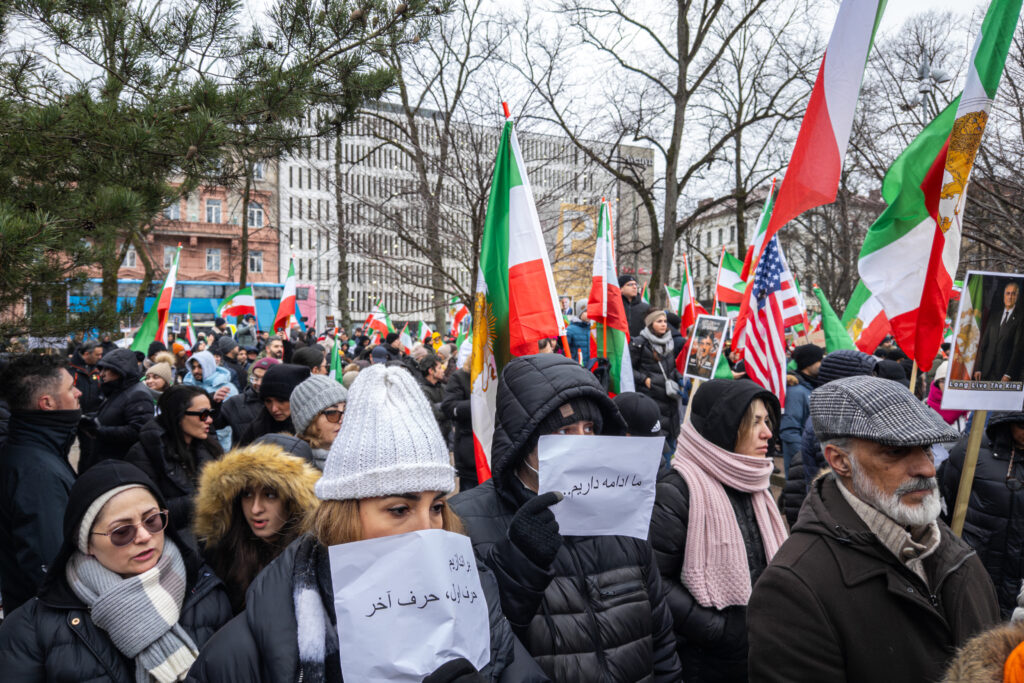
Anti Iranian Regime protests 2026 Gothenburg, Wikimedia Commons
By Susan D. Harris
I remember watching the life fade from Neda’s eyes like it was yesterday. It’s hard to believe it’s been 17 years since we saw those haunting images of a beautiful Iranian girl dying on camera for the whole world to see. Neda Agha-Soltan was a 27-year-old music student shot down during the 2009 Green Movement in Iran. That June, 3 million took to the streets to peacefully protest the alleged reelection of President Mahmoud Ahmadinejad. In short, they believed the election was rigged. Dozens—perhaps hundreds—of protestors were killed the same day as Neda; we’ll never know for sure.
Reportedly, Neda and her music teacher were just driving by when they decided to get out and walk with the crowd of protesters. They had only been there a short time when Neda, who was talking on her cell phone, was shot in the upper chest by Basij militia—per eyewitness accounts.
Some witnesses said she was targeted, though the reason is unclear. Perhaps it was because she was a woman—in a country where female protesters were routinely beaten, shot, and killed by regime security forces to crush resistance to the Islamic Republic’s patriarchal control. (Years later, during protests after the death of a Kurdish-Iranian woman, Mahsa Amini, medics reported that Iranian forces “were shooting at faces and genitals of female protesters.”)
The iconic Irish rock band U2, fronted by Bono, showed support for the Green Movement during their U2 360° Tour. They dedicated the song “Sunday Bloody Sunday,” to the protestors, bathing the stage in green light and yelling, “Iran, can you hear us?” People around the world were praying that Iranians could finally throw off their oppressive regime, but they were once again forced into submission, and their voices fell silent.
American memories go back even farther than that. In my 1989 college newspaper office, we were still using an Ayatollah Khomeini dartboard. It had been ten years since Tony Orlando’s “Tie a Yellow Ribbon Round the Ole Oak Tree” was repurposed to symbolize the return of American hostages being held in Iran. Then, I had gone to the store with my mother to buy a spool of wide yellow ribbon to make 52 bows to tie around our flagpole in the front yard—one for every hostage.
These are the things that have defined Iran in our memories for decades: the hostage crisis that started it all, the bloody suppressions of protests, the targeting of women and dissenters, and the hardline regime’s relentless grip.
Today In the streets of Tehran, Mashhad, and Isfahan, Iranians are once again risking it all to demand an end to nearly a half century of oppression under the Islamic Republic. Well into their fourth week, these protests—ignited by economic collapse but driven by a profound desire for freedom—show no signs of fading. Despite internet blackouts and violent crackdowns, videos continue to emerge showing defiant crowds confronting security forces and raising the pre-revolutionary Lion and Sun flag.
Chants for Reza Pahlavi’s return are heard beyond Iran: “Long live the Shah,” “Pahlavi will return.” Reza is the son of the last Shah (king) of Iran—Mohammad Reza Pahlavi—who fled Iran in January 1979 after the Islamic Revolution that brought Ayatollah Khomeini to power. (Who can forget the brave, young 20-year-old Reza Pahlavi announcing himself “King Apparent” after his exiled father’s death from cancer in 1980?)
These are not isolated cries; they reflect a growing consensus around the exiled crown prince as a figure who can guide Iran toward secular democracy, human rights, and prosperity.
Australian commentator Rita Panahi, a passionate Trump supporter and Iranian-Australian whose family fled the regime after the 1979 revolution, has been capturing the momentum. In her recent commentary, she declared the Islamist regime “doomed,” pointing to key realities: Iran is not an Arab country, Persians are not Arabs, only about one in three Iranians practices Islam actively, 50,000 mosques have closed, and dozens more have been burned in recent days. “Iran was first conquered by Islam in 630AD… the last time was 1979” she wrote.
Panahi, who left Iran as a child, has long advocated for liberation. Currently she’s embracing the rallying cry “MIGA”—Make Iran Great Again. She’s expressed renewed hope under Trump: “For the first time EVER I believe Iran can be liberated in my lifetime. Trump is a revolutionary leader.” With Trump at the helm, she believes Iran’s “courageous freedom fighters have hope that the mad mullahs can be defeated.”
Rita has shared a favorite picture of her “mum” on social media a number of times, highlighting the freedoms women enjoyed before the Islamic Revolution and contrasting them with the repression that followed.
Her personal experience resonates deeply—memories of pre-revolution Iran versus the theocracy that followed—and underscore the resolve of a people who remember freedom.
President Trump has so far responded with the strategic foresight that defines his leadership. He weighed military options but seems to have paused plans for immediate strikes. After all, any action with existing forces could provoke retaliation without securing the preferred result. Instead, he redirected the USS Abraham Lincoln Carrier Strike Group from the South China Sea to the Middle East, positioning it to arrive in about a week. This action is set to bolster deterrence, safeguard U.S. interests, and keep our options open.
Meanwhile, President Trump has told Iranian protestors to keep protesting and promised them that help is on the way:
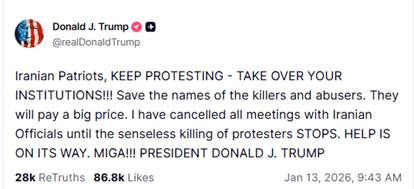
His approach stands in stark contrast to prior administration’s policies of appeasement that enriched Tehran and prolonged its oppression.
By redirecting a carrier strike group toward the Middle East, the president is positioning U.S. forces for potential deterrence or limited response options—avoiding a large-scale, open-ended military commitment that nobody wants.
So far, the protesters’ bravery has been gut-wrenching: Despite live fire, mass arrests, and “growing evidence of countrywide massacres,” resistance persists.
As constitutional lawyer and author Mark Levin has stressed, the situation is dire. He pointed out that most of the people being killed in Iran today are young people around 18 or 19 years old—who want what every young American wants: to go to a movie on Friday night, not to be forced to cover their hair or faces, to go on a date and dance and have a drink. Instead, they’re protesting and being murdered, imprisoned, tortured, or raped.
How many people have been killed during the current protests? On January 13, CBS reported that “a source inside Iran who was able to call out told CBS News on Tuesday that … based on reports from medical officials across the country … the toll was at least 12,000, and possibly as high as 20,000.”
Not surprisingly, Iranian authorities have imposed an internet blackout, so very few reports are coming out. Thankfully, Elon Musk’s Starlink has proved a crucial tool thus far—estimates suggest possibly hundreds of thousands of smuggled Starlink terminals are in use. However, they’re illegal in Iran, and often hidden on rooftops. And despite the help, very little information seems to be leaving the country. The latest reports indicate that the Iranian regime is successfully jamming Starlink signals.
History demonstrates that internal pressure, paired with external resolve, can topple tyrants. The regime’s hold weakens daily. With Trump’s guidance, the road to a liberated Iran appears more attainable than ever. The world is watching, and President Trump must keep his word. Countless lives have been brutally cut down since 1979; Iran cries out for liberation, and the time for freedom is now!
Originally published in The Epoch Times https://www.theepochtimes.com/opinion/from-hostage-crisis-to-mass-graves-iranians-long-fight-for-freedom-5973854